
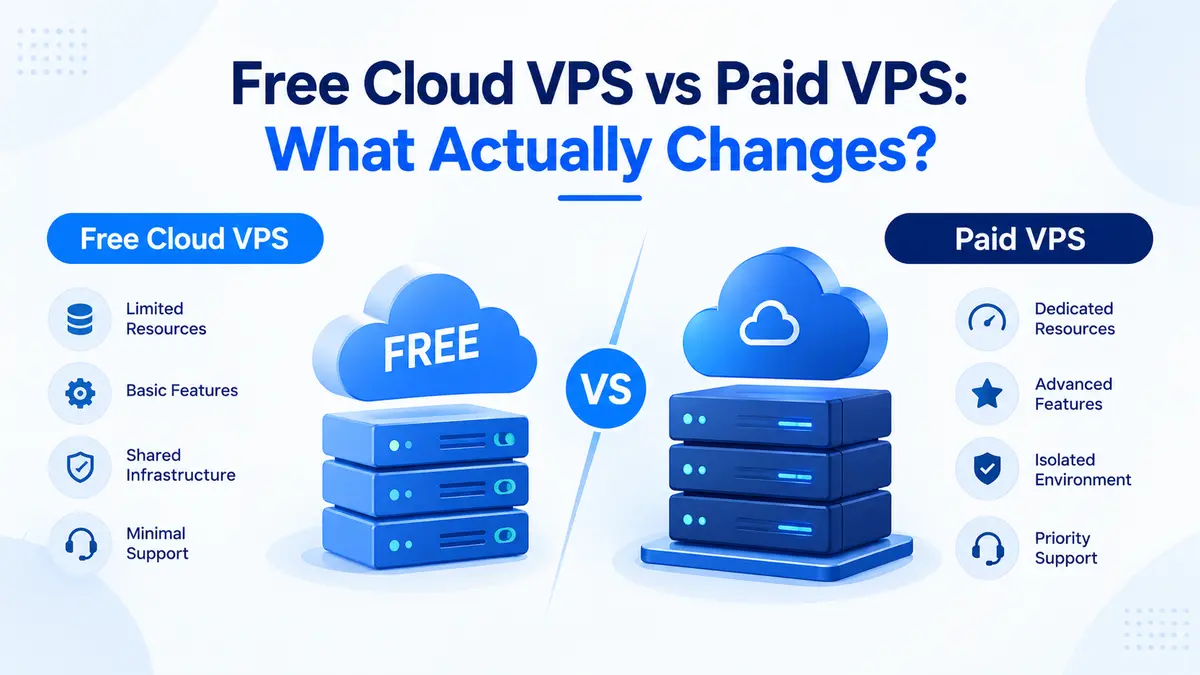
A free cloud VPS sounds like the perfect starting point. You get the virtual server environment without paying a monthly hosting bill, which makes it attractive for students, developers, hobby projects, and anyone experimenting with server-based applications.
Also Read – https://digieminence.co.in/how-to-choose-professional-web-templates-for-your-industry/
But free does not mean equivalent to paid VPS hosting. The differences appear in CPU resources, RAM, storage, network performance, uptime, support, security, and even the granular control you have on the server.
So, what really changes when you go from a free cloud VPS hosting to a paid VPS? The answer is not simply removing the price tag. With a paid VPS you usually get predictable resources and services designed for applications that require consistent performance.
CPU Resources Become Predictable
VPSs are CPU hungry and require CPU resources to run the application requests, databases, background tasks, and website visitors. Free VPS plans have limited CPU resources or are on stricter terms.
A paid VPS gives you the defined CPU amount based on the selected plan. Estimating server workload and planning for future growth becomes easier.
You Get More RAM for Real Workloads
RAM influences how many and what processes a server can handle efficiently. You can run simple applications with a small amount of memory, but databases, control panels, web servers, caching systems or application processes use it.
Free VPS environments have strict memory limits, so they are good for light workloads. Paid VPS plans can choose more RAM. This can be useful if you need to host multiple websites, run databases, deploy frameworks, or manage applications that require more memory.
Storage Capacity and Performance Can Improve
Storage isn’t about how many gigabytes you get. The underlying storage technology determines how fast a server can write data or read data. Free VPS might have some space for storage that could be used for simple experiments.
Those limits are restrictive once you start storing databases, application files, backups, logs, media or a few websites. Paid plans come with a larger storage allotment and also offer faster storage technology such as SSD or NVMe depending on the plan or provider.
Network Resources Are Less Restrictive
Your server’s network connection affects how quickly visitors communicate with the applications and transfer data effectively. Free VPS services impose bandwidth limits, traffic restrictions, throttling, or other usage conditions.
Limitations might not matter while testing an application with a few users. However, once the server starts receiving regular traffic, transferring large files, serving media, or handling APIs, network limitations become a bottleneck.
Uptime Becomes More Important
The development server goes down every once in a while, but it doesn’t cause too much havoc. A business web site or production app is a different thing. Free services usually have lower uptime commitments, fewer infrastructure commitments, or policies that allow for the reclamation or suspension of resources under certain conditions. Premium VPS hosting for round-the-clock production use Depending on your provider and your plan, you may also get an uptime promise or a service-level agreement.
Support Changes Significantly
Available customer support is one of the major differences between free and paid hosting. Free VPS offerings rely heavily on documentation, community forums, knowledge bases, or self-service troubleshooting. This is perfectly reasonable when you are learning how servers work.
With a paid VPS, providers offer technical support depending on the plan. It is valuable while you encounter networking issues, server configuration problems, resource limits, or other hosting-related issues. You are not simply paying for server resources. In such cases, you pay for access to an infrastructure provider helping you to keep the environment running.
Security and Infrastructure Features Can Expand
A VPS itself doesn’t automatically make an application secure. The following factors are important for ensuring security: server configuration, operating system updates, access controls, firewalls, application security, and backups. A free VPS environment gives the basic server resources without many infrastructural features.
You may need to configure security and backup mechanisms. VPS paid plans offer additional features such as automatic backups, DDoS protection, firewall tools, monitoring, managed services, or security support, depending on the hosting provider.
Resource Scaling Becomes Easier
Your initial server requirements may be small. But what happens when your application scales? A free VPS has restricted upgrade options, forcing you to migrate to another environment when needs exceed the available resources.
Paid VPS providers often have many configurations. As your workload scales, you can upgrade from a smaller plan to one with more CPU, RAM, storage, or bandwidth.
Summary
The most significant difference between free cloud VPS and paid VPS is not just the price. It is the predictability, resources, reliability, support, and production readiness you expect from the infrastructure.
Free VPS hosting is a wonderful environment for learning and testing. That allows developers and new users to try things out without the monthly infrastructure fee. But when a website or app becomes a must-have for consumers, the math changes. The value of reliable resources, backups, security, support, uptime and scalability often far outweighs the monthly VPS bill.
